Performance beyond words

Uses of Monensin as an Antimicrobial and Its Role in Bioethanol Fermentation
Blog post description.
12/6/20251 min read
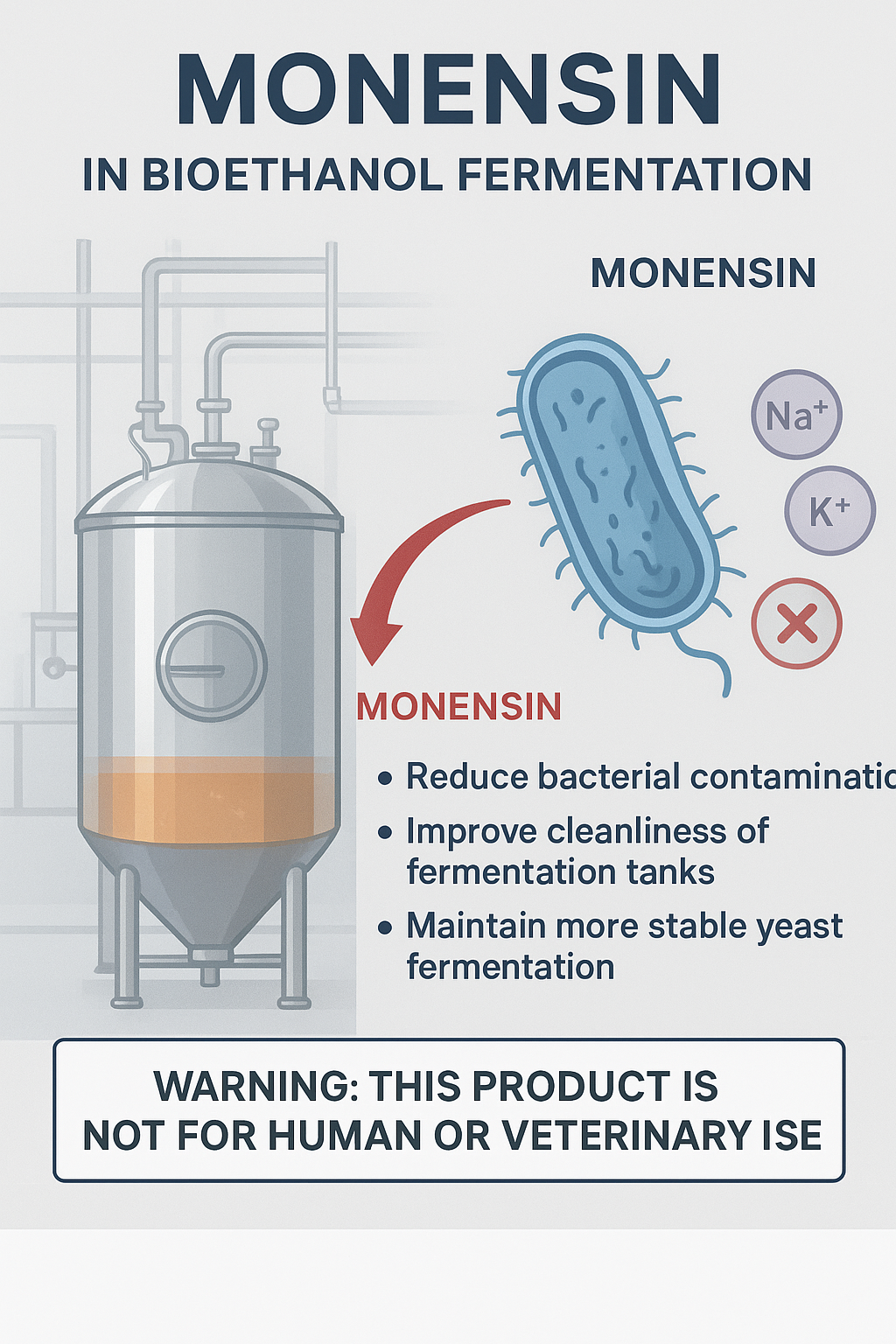
Monensin is a naturally occurring ionophore antibiotic that transports monovalent cations such as sodium and potassium—across lipid membranes. By disrupting a cell’s pH balance and Na⁺/K⁺ gradient, it interferes with essential cellular processes. This disturbance can lead to cell death, particularly in Gram-positive bacteria like Micrococcus, Bacillus, and Staphylococcus, with minimum inhibitory concentrations (MICs) ranging from 1–12.5 μg/mL.
Beyond bacteria, monensin also reduces the proliferation of protozoan parasites, including Plasmodium falciparum (malaria parasite) and Coccidium species, and can inhibit the replication of certain viruses by altering intracellular ion conditions critical for viral development.
Why it was used
During bioethanol fermentation, certain bacteria (especially Lactobacillus and other lactic-acid–producing species) can:
-Consume sugars that yeast need
-Produce lactic acid, which inhibits yeast
-Lower ethanol yield
Monensin targets Gram-positive bacteria, so in some operations it was evaluated or used to:
-Reduce bacterial contamination
-Improve cleanliness of fermentation tanks
-Maintain more stable yeast fermentation
-Slightly increase ethanol output by reducing bacterial competition
WARNING: This product is not for human or veterinary use.
SERVING GLOBALLY
Brazil | UAE | India | Europe | Argentina | Bangladesh | Malaysia | Indonesia | Afghanistan | Ecuador | Moldova | Turkey | Philippines | Algeria | Romania | Thailand | Vietnam | Nepal | Mexico | Honduras | Georgia | Venezuela | Peru | Spain | Tanzania | Columbia | Azerbaijan | Australia | Austria | Belgium | Canada | Czech Republic | Denmark | Finland | France | Germany | Greece | Hong Kong | Hungary | Iceland | Ireland | Israel | Italy | Japan | Korea | Luxembourg | Malaysia | Netherlands | New Zealand | Norway | Poland | Qatar | Romania | Singapore | Spain | Sweden | Switzerland | Taiwan | Turkey | United Kingdom | United States
CALL / WHATSAPP +55 11 97038-7347


CALL / WHATSAPP 08069640531